
Wednessday, August 21, 2024
– Live Presentation with Bruce Torrence –
Session at 12 Noon Atlanta time
(check your time here)
Please join us starting 10 minutes before this session using the following button.
For published CoM presentations please visit the G4G YouTube channel
After this virtual CoM presentation on Zoom, we will meet for an informal social session in a different Zoom space where we can all see each other (see the blue button below). That Zoom meeting will start around 1pm ET.
Please join the social using the following button:
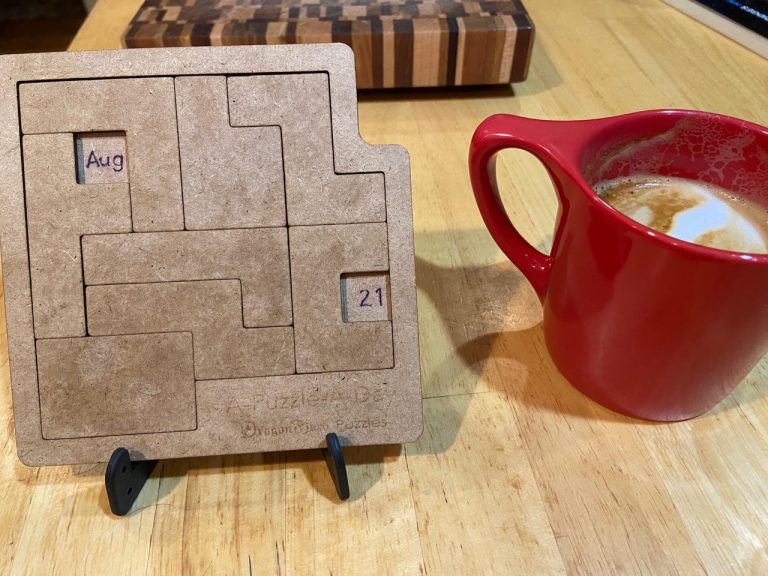
A New Kind of Play for A-Puzzle-A-DayWe typically build jigsaw puzzles piece by piece, starting with an empty tabletop and adding one piece at a time. For a puzzle whose pieces are polyominoes (which can fit together multiple ways) we explore a different paradigm: Starting from a completed puzzle, we perform a sequence of “moves” whereby an individual piece or an assemblage of contiguous pieces may be rotated or flipped, or pairs of such pieces or assemblages may be swapped, in order to arrive at a different configuration. In this talk, we will explore this paradigm using A-Puzzle-A-Day, an eight piece polyomino puzzle that has different solutions for each day of the calendar year. While challenging, this mode of play is so versatile that from a single starting configuration, a sequence of moves can be made to reach a solution for any calendar date.

Bruce Torrence is Professor Emeritus of Mathematics at Randolph-Macon College, where he taught from 1993 – 2021, and served as the Mathematics department chair for over 20 years. He now serves as co-curator for the Exhibition of Mathematical Art, Craft, and Design for the annual Bridges Conference, and as editor for the Anneli Lax book series for the Mathematical Association of America. In 2008 he received the John Smith Award for distinguished teaching from the Mathematical Association of America. He was an editor of Math Horizons magazine from 2008-2013, and he is coauthor (with wife Eve Torrence) of The Student’s Introduction to Mathematica, now in its third edition. Trained as an algebraic topologist, he has a longstanding interest in computer algebra systems. His current research focuses on combinatorial games and graph theory.