
Saturday, September 21, 2024
– Live Presentation with Aaron Williams –
Session at 12 Noon Atlanta time
(check your time here)
Please join us starting 10 minutes before this session using the following button.
For published CoM presentations please visit the G4G YouTube channel
After this virtual CoM presentation on Zoom, we will meet for an informal social session in a different Zoom space where we can all see each other (see the blue button below). That Zoom meeting will start around 1pm ET.
Please join the social using the following button:
Next Steps for Sequential Puzzles: Ziggu Mazes and Grey CodesIn August 1972, Martin Gardner’s Mathematical Games column was titled “The curious properties of the Gray code and how it can be used to solve puzzles.” In this article, Gardner explained how the two classic sequential puzzles — the Towers of Hanoi and Baguenaudier (Chinese Rings) — can be solved using the order. Subsequent years brought closely related puzzles like Spin-Out and The Brain. More recent puzzles like Crazy Elephant Dance, Rudenko’s Disc, and Panex Jr use non-binary Gray codes or allow or force variations of the binary Gray code to be used.
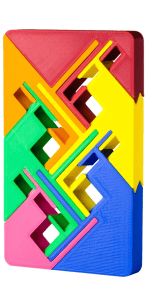
In this talk we consider next steps for sequential puzzles. We will start by focusing on Ziggurat by Eitan Cher and Bram Cohen, along with the ever growing collection of Ziggu* puzzles by Oskar van Deventer. Then we consider a new general framework for creating sequential puzzles with more choices using generalized Gray codes called Grey codes. A special case of this new framework was previously used by William Keister in the Hexadecimal Puzzle although we’ll see that he did not find the optimal solution to his puzzle! In both cases we follow Gardner’s lead by considering optimal solutions and other curious mathematical and algorithmic properties.
This is joint work with Madeleine Goertz (Cal Poly SLO) and Petr Gregor (Charles University).

Aaron Williams received his Ph.D. in Computer Science from the University of Victoria in 2009. His graduate work focused on combinatorial algorithms, and in particular, the efficient generation of combinatorial objects using minimal-change orders known as Gray codes. Before coming to Williams College, Aaron held a series of postdoctoral positions at Canadian universities including Guelph, Carleton, and McGill. He was then an Assistant Professor at Bard College at Simon’s Rock from 2014 to 2018. Prior to graduate school, Aaron was a programmer for computer graphics software at Corel and Discreet Logic / Autodesk.